Ario Simulate

Run the simulation.
Skip the field study.

Ario Simulate runs simulations on digital twins built from real purchase histories. Ask messaging, concept, positioning, or pricing questions — and get per-twin answers in minutes, not weeks.

How it works

From question to answer, in three steps.

1
Pick a panel — Choose a saved panel of twins, or build one from any demographic, behavior, or category attribute.
2
Build the simulation — Write the question yourself, pick a template, or edit one to fit your scenario.
3
Get per-twin answers — Run it. Every twin responds based on their real purchase history. Aggregate results, in minutes.
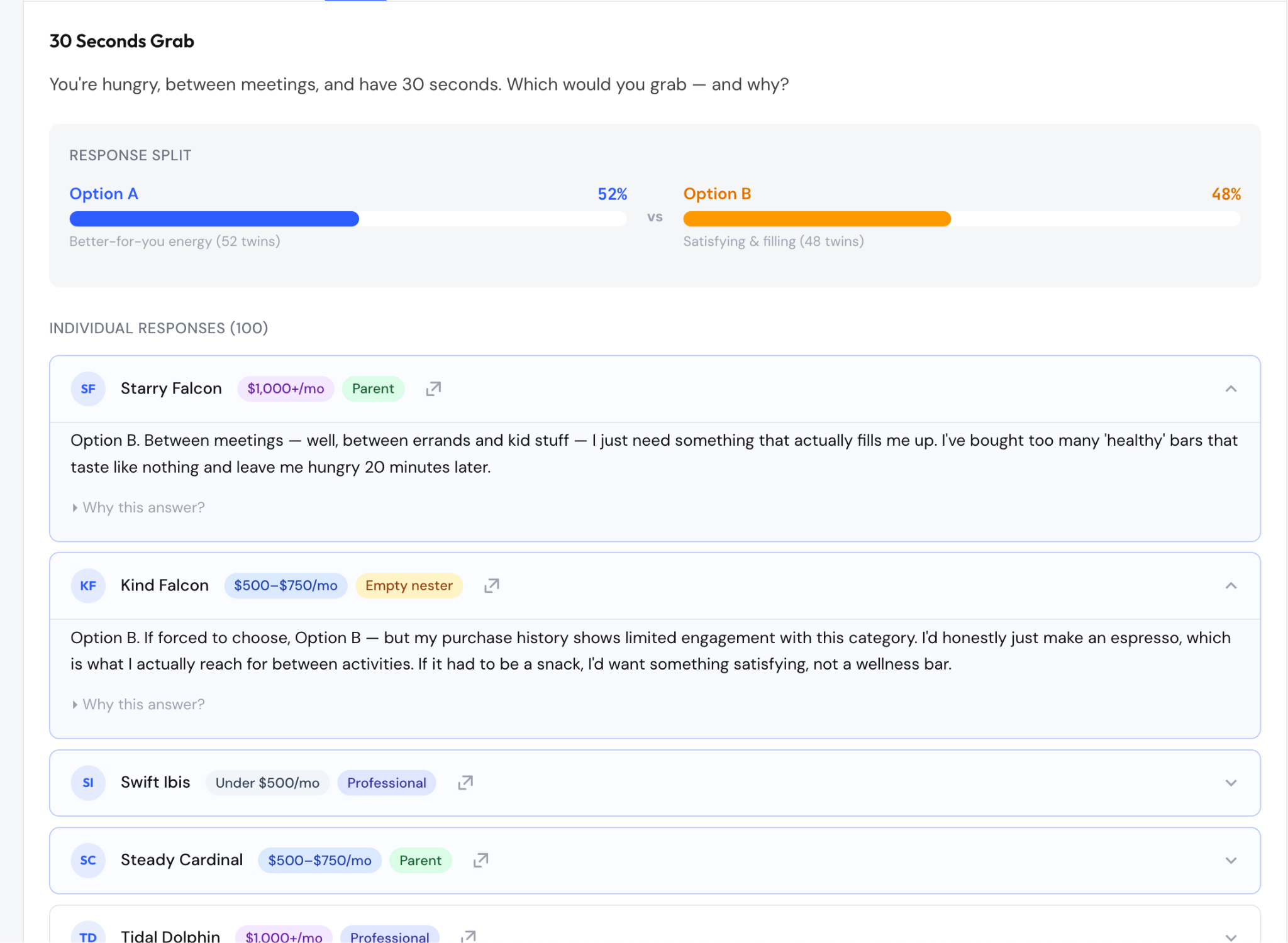
Ario Simulate · Simulation results
Ario Simulate results page showing a 30 Seconds Grab simulation: aggregate response split between Option A (52%, better-for-you energy) and Option B (48%, satisfying & filling), plus individual twin responses with demographic tags.
Step 3 — aggregate split + per-twin reasoning
What you can ask

Templates for the simulations brands run most.

Start with a template and edit, or write your own from scratch. Either way, the twins respond based on their real purchase history.

Price Change
Will my buyers stay if I raise the price?
"How would you respond if [Brand]'s price moved from $X to $Y?"
Competitive Threat
What happens if a competitor launches X?
"Would you try [Competitor]'s new launch in this category? Why or why not?"
Packaging Change
Does the new packaging resonate?
"Compared to the current pack, does this design change what you'd buy?"
New Product
Would my customers buy this?
"Here's a new product concept. Would you try it? At what price?"
Messaging Test
Which value-prop lands?
"Rank these three messages by how well they speak to you, and explain."
Custom
Or write your own.
"Anything a panel could answer — just type the question and run it."
How the twins work

Grounded in real behavior, not generic personas.

A twin isn't a generic LLM character. It's a profile built from a real respondent's longitudinal SKU-level purchase history — brands bought, basket composition, switching behavior, price sensitivity. Every simulated answer is rooted in that twin's actual behavior.

What grounds each twin

Years of real, customer-consented purchase history per twin. Brand share, frequency, basket, switching, price moves — all observed, not assumed. Demographics layer in where available.

Where simulation excels

Behavior-adjacent questions — price sensitivity, brand switching, category trade-offs, packaging preferences. The twin's history directly informs the prediction.

Honest about the limits

Simulated answers are predictions, not measured behavior. For high-stakes decisions, validate the winning option with a real CoreLens study on the same audience.

Common questions

Frequently asked questions

If your question isn't here, get in touch.

Real studies measure what respondents actually said or did. Ario Simulate predicts how a panel of digital twins would respond, based on each twin's real purchase history. Use Simulate for fast iteration on concepts, messaging, pricing, and positioning. Validate the highest-stakes decisions with a real CoreLens study.
Each twin is a profile assembled from a real respondent's longitudinal SKU-level purchase history — brands bought, frequency, basket composition, switching behavior, price sensitivity, category preferences. Demographics are layered in where available. Responses are generated by an LLM grounded in that twin's specific behavioral profile, not a generic persona.
We benchmark Simulate against real survey results on the same audiences. Accuracy is highest for behavior-adjacent questions (price sensitivity, brand switching, category trade-offs) and lower for questions disconnected from purchase history (politics, abstract values). We publish benchmark methodology — happy to share.
Anything you'd ask a panel: messaging tests, concept fit, positioning, price-change reactions, packaging preferences, competitive scenarios, new-product appeal. Templates are available for the common cases — or write a question from scratch.
Same twins, different question. CoreLens delivers real measured behavior on a defined audience. Simulate runs synthetic question-and-answer on those same twins. Most teams use them in sequence — Simulate to iterate fast, CoreLens to validate the winner.
Yes. Any panel you've defined in CoreLens (saved by attribute, behavior, brand, or category) can be turned into a Simulate panel with one click. You can also build new panels from scratch using the same filtering library.
Try it

Run your first simulation.

Bring a question. We'll set up a panel, run the simulation, and walk you through the results.

Talk to us